Matching Threat Levels with Correct Blade Profiles
Choosing the correct blade profile directly impacts both the project budget and the security level achieved. Understanding the difference between BTO-22 and CBT-65 razor wire in field application allows procurement managers to match threat levels with appropriate hardware geometry.
Field Comparison
To illustrate the difference in everyday application, look at two simultaneous projects completed within the Subic Bay region.
Project A (Logistics Warehouse): Opted for BTO-22.
The shorter blade length provides a compact profile that mounts easily onto standard commercial chain-link fences without causing excessive top-heavy sagging.
Project B (Correctional Facility): Opted for CBT-65.
The long, spear-like blades create an intimidating visual profile that works as a powerful psychological psychological barrier on high-security concrete walls.
Technical Feature Contrast
1.Blade Length
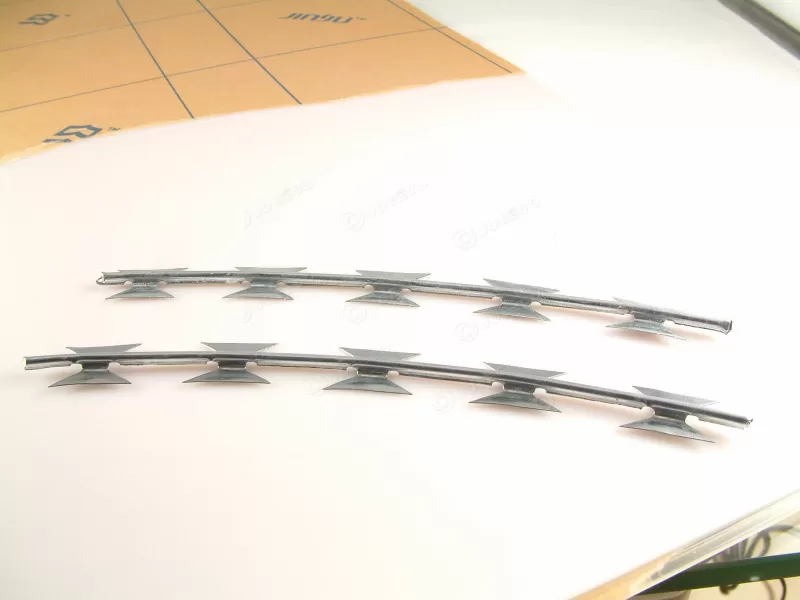
BTO-22: 22 mm (±1mm)
CBT-65 : 65 mm (±2mm)
2.Blade Width
BTO-22 : 15 mm
CBT-65 : 21 mm
3.Blade Spacing
BTO-22 : 34 mm
CBT-65 : 100 mm
4.Main Function
BTO-22 : Catches and entangles clothing, inflicts standard cuts on contact.
CBT-65 : Deeply hooks thick fabrics, inflicts severe lacerations, completely stops physical scaling.
Practical Purchasing Advice
For standard commercial properties, industrial parks, and railway lines where cost efficiency per meter is a primary driver, BTO-22 offers optimal protection at an accessible price point.
However, for critical national infrastructure, military installations, and prisons where human breaches must be stopped absolutely at first contact, the massive physical footprint of CBT-65 is the mandatory choice.