Choosing between JOESCO barriers and cast-in-place concrete blast walls is one of the first decisions a base commander, project engineer, or procurement officer faces when hardening a site. The answer is rarely “concrete everywhere.” This guide compares the two systems on the metrics that actually drive procurement decisions — installation speed, unit cost, blast performance, logistics, and lifecycle — so you can specify the right barrier system with confidence.
How the Two Systems Work
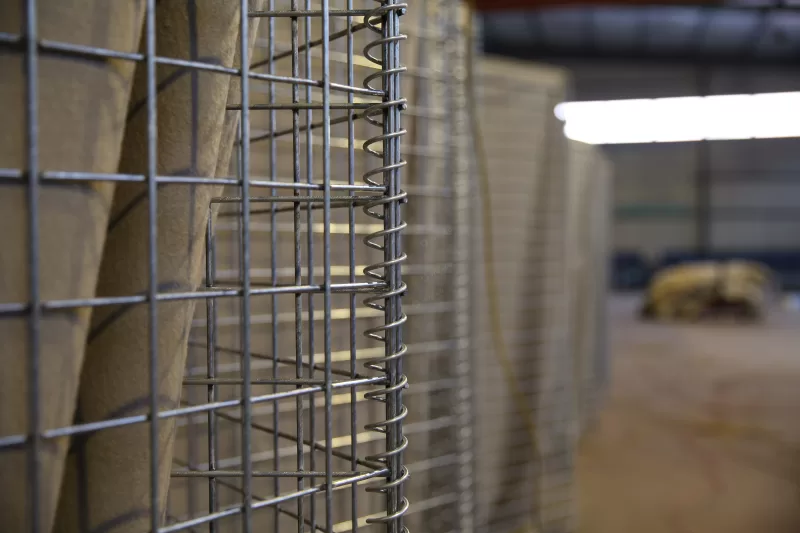
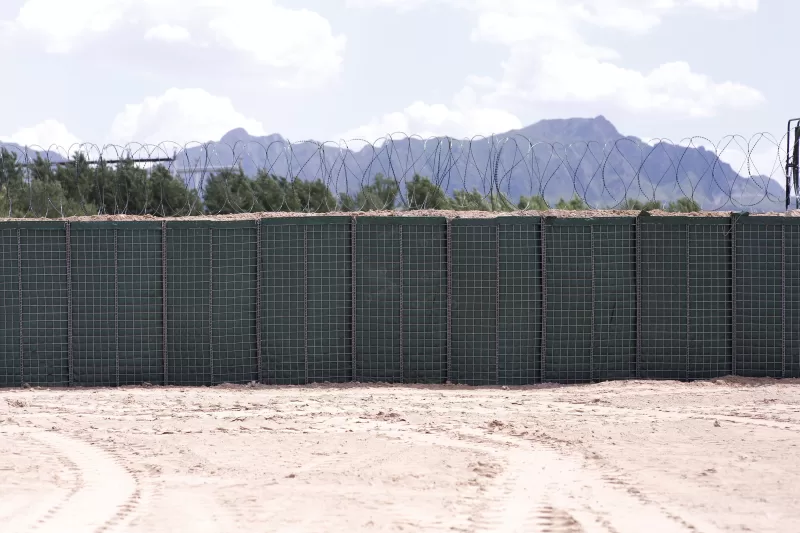
A JOESCO barrier is a collapsible wire-mesh container lined with heavy-duty geotextile fabric. On site, crews unfold the unit, lock the corner posts, and fill it with locally available soil, sand, or gravel using standard loaders or excavators. No curing time, no formwork, and no ready-mix plant are required.
Concrete blast walls, by contrast, are either cast in place with rebar-reinforced pours or delivered as precast panels. Both variants demand heavy craneage, a concrete supply chain, curing windows, and skilled crews on site for weeks.
Head-to-Head Comparison Table
| Factor | JOESCO Barrier | Concrete Blast Wall |
|---|---|---|
| Install speed | 1,000+ m per crew-day with loader | 15–40 m per crew-day including cure |
| Site prep | Minimal; works on uneven ground | Requires level strip footings, rebar |
| Logistics | Flat-packed pallets, container-friendly | Heavy precast slabs or in-situ pour |
| Blast performance | Proven against vehicle bombs and fragments (see test data) | Strong point-blank, but spalls and is rigid |
| Adaptability | Relocatable, reusable, reconfigurable | Permanent; demolition cost to remove |
| Unit cost | Lower delivered cost per running meter | Higher when logistics, labor, cure are counted |
| Environmental footprint | Uses on-site fill; fully removable | Large carbon footprint, permanent scar |
Blast and Ballistic Performance
Independent tests have repeatedly validated wire-mesh-and-fill systems against vehicle-borne improvised explosive devices and small-arms fire. When the soil fill is compacted in lifts, the mass of the barrier absorbs and deflects blast energy, while the mesh contains fragments. Our military barrier test results document displacement and fragment-containment performance under controlled charges.
Concrete performs differently: it offers very high stiffness, but point-blank detonations can spall concrete shards that become secondary projectiles — a real hazard for personnel behind the wall. Hybrid schemes that combine a soil-filled barrier in front with a hard wall behind are increasingly common in high-threat zones.
Speed of Deployment in the Field
Time is the deciding factor in most real-world missions. In flood events, units must go up before water arrives. In force-protection upgrades, gates and roadblocks must be operational before the threat window closes. Because rapid deployment barriers can be erected at several hundred meters per hour with a single loader, they are the standard answer for emergency and expeditionary sites.
Concrete’s curing time alone — typically 7 to 28 days to full design strength — rules it out wherever speed matters. A common compromise is a concrete core wall with Hesco-style wings for the areas that need to be up tomorrow.
Cost and Logistics Over the Full Lifecycle
Look beyond the sticker price. A precast wall requires road permits for wide loads, crane hire, skilled labor, and eventual demolition. A JOESCO barrier ships flat: one 40-ft container holds roughly 50 to 60 linear meters of barrier, and any loader operator can build it. At the end of the mission the fill returns to the ground and the mesh packs flat for reuse — a decisive advantage for contingency contractors and aid organizations who operate on tight budgets. See military barrier case studies for real project comparisons.
Weight, Transport, and Site Constraints
Weight shapes every logistics decision. A completed 2 m JOESCO wall is massively heavy once filled — typically 1.5–2 tonnes per linear meter — but that mass appears only at the site, sourced from local fill. Before filling, a pallet of units is light enough for a medium truck or even helicopter sling loads in expeditionary settings. Concrete, by contrast, carries its weight from the plant to the site in finished form, which constrains access routes, bridge ratings, and crane positioning before construction even starts. Sites with poor access, overhead lines, or weight-restricted roads often find that soil-filled systems are the only viable option within budget.
When Concrete Is Still the Right Call
Concrete remains appropriate for permanent perimeters that will stand for decades with zero relocation, where ground conditions are stable, and where local blast codes require hardened construction. For everything else — temporary, semi-permanent, rapidly evolving perimeters, flood defenses, and expeditionary bases — the JOESCO barrier is the faster, cheaper, and more flexible system.
FAQ
Are JOESCO barriers blast-rated?
They have been validated in full-scale vehicle-bomb and fragment tests; request our test documentation for certified displacement and fragment-containment data.
How long does a JOESCO barrier last?
With galvanized wire mesh and proper fill, service life typically exceeds 10–15 years in outdoor exposure; sacrificial and maintenance requirements are minimal.
Can JOESCO barriers be used for flood control too?
Yes — the same units form rapid flood levees. See our application guide for water-retention configurations.
How much does a JOESCO barrier cost per meter?
Delivered cost depends on height, wire gauge, and volume; contact our team for a quote against your specific threat and terrain.
Bottom line: for speed, cost, and flexibility, JOESCO barriers beat concrete blast walls in most defense and disaster-response scenarios. Request a quote from our engineering team and we will size the system to your threat level, footprint, and schedule.